Accumulate resources
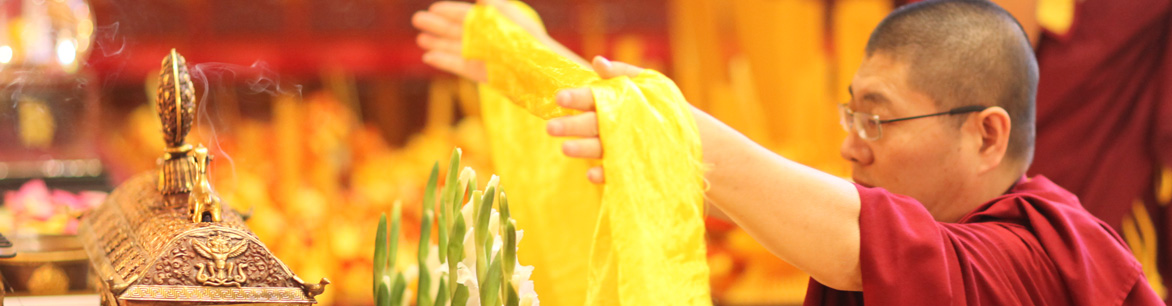 Offering mandalas is the supreme method for accumulating merit.
Buddhist scriptures record: "Until the two accumulations of merit and wisdom are perfected, one cannot realize the supreme emptiness." And, "Know that the innate wisdom of ultimate truth arises solely from the power of accumulating merit and purifying obscurations, and is aided by the blessings of a realized master. Relying on other teachings is truly foolish." The Venerable Dorje Chang Tilopa also said: "My son Naropa, this present arising is dependent origination; before realizing the meaning of non-arising, do not depart from accumulating the two accumulations." Therefore, while purifying our karma, we must continuously accumulate the two accumulations of merit and wisdom. Only when the two accumulations of merit and wisdom are perfectly complete can we attain the Buddhahood, possessing both purity.
The Buddha, with skillful means and great compassion, expounded inconceivable methods for accumulating merit, the most supreme of which is "offering a mandala." As recorded in the tantras: "If one adorns all the Buddha-lands, without exception the three thousand worlds, with wondrous virtues, and offers them to the perfect wisdom of the Buddha."
The choice of materials for the mandala depends on one's financial situation. The highest quality mandala is made of gold, silver, and precious stones, while medium quality mandala is made of bronze. Some mandalas are also made with smooth surfaces such as stone slabs or wooden planks. The offerings for the mandala, i.e., the mound itself, are made of precious stones such as turquoise, coral, lapis lazuli, and pearls. Less desirable offerings include medicinal herbs and fruits such as chebula (Tibetan barley) and amla (olive fruit). Grains such as barley, rice, wheat, and beans can also be used. Alternatively, pebbles, tiles, and sand can be used as the object of meditation. It is important to very carefully rub the base of the mandala with your wrist.
There are two types of "offering mandalas": "the mandalas that are practiced" and "the mandalas that are offered".
「The "mandala practice" is performed according to the object of the offering. First, on the base of the mandala practice, place offerings, such as gold, pearls, agate, or grains, in piles in the center and in the five directions of east, south, west, and north.
If the Five Dhyani Buddhas are the objects of offering; first, visualize the central group as Vairocana Buddha, surrounded by the Buddha family deities. Next, visualize the eastern group as Akshobhya Buddha, surrounded by the Vajra family deities. Then, visualize the southern group as Ratnasambhava Buddha, surrounded by the Jewel family deities; the western group as Amitabha Buddha, surrounded by the Lotus family deities; and the northern group as Amoghasiddhi Buddha, surrounded by the Karma (action) family deities.
The object of offering is the Refuge Field. In the center, visualize Padmasambhava, who is inseparable from the root guru, and the masters of the Dzogchen lineage, seated in a stacked arrangement. In front, visualize Shakyamuni Buddha surrounded by 1,002 Buddhas of the Bhadrakalpa. On the right, visualize the eight great attendant bodhisattvas surrounded by Mahayana (Bodhisattva) saints. On the left, visualize the two supreme masters, Sravakas and Pratyekabuddhas, led by Shariputra and Maudgalyayana, surrounded by Hinayana Arhats and saints. Behind, visualize the radiant sutra shelf behind the Refuge Field, where layers of Dharma treasures and scriptures are stacked.
When placing piles of offerings on the mandala plate, by placing five piles of precious jewels and grains, we visualize the Buddhas and Bodhisattvas we cultivate as real beings in the space before us.
Finally, the "mandala of practice" should be placed on the offering table. If possible, five offerings can be arranged around it. Offerings are made before the objects of body, speech, and mind. If conditions are not met and the "mandala of practice" is not available, one can visualize the field of merit in one's mind.
When performing the "Offering of Thirty-Seven Heaps of Mandala," treat the mandala plate as a mandala. Hold the mandala in your left hand, lift the mandala plate, and then wipe the base plate with your right wrist. At the same time, focus your mind on the object of your meditation and recite the Seven-Branch Offering without distraction.
When wiping the mandala plate, you must not use any cloth to wipe it; you must wipe it with your wrist. The main reason is not that the mandala plate is unclean, but that our body, speech, and mind have created impure karma, and we need to purify the defilements of the two obscurations in our mindstream through ascetic practices.
There are many ways to offer a mandala, and each school has its own ritual. Any ritual can be used. The "Thirty-Seven Heap Mandala Ritual," which is commonly practiced today, was created by Phagpa, the Sakya Trizin, the Protector of All Beings. Because it is simple and easy to perform, it is used by both old and new schools. Each terma (hidden treasure) of the Nyingma school contains a mandala offering ritual. Therefore, it is acceptable to use any ritual for offering.
-
-
-
-
-
- Vows and Precepts
- Preliminary Foundations of the Path
- Generation Stage
- Meditation Practice
- Precious Human Rebirth
- Impermanence of All Things
- Infallible Cause and Effect
- Suffering of Samsara
- Liberation and Benefit
- Reliance on the Guru
- Refuge
- Prostration
- Generate Bodhicitta
- Vajrasattva Mantra Practice
- Accumulating Merit
- Guru Yoga
-
-
-
-