Body, speech and mind in harmony with the guru
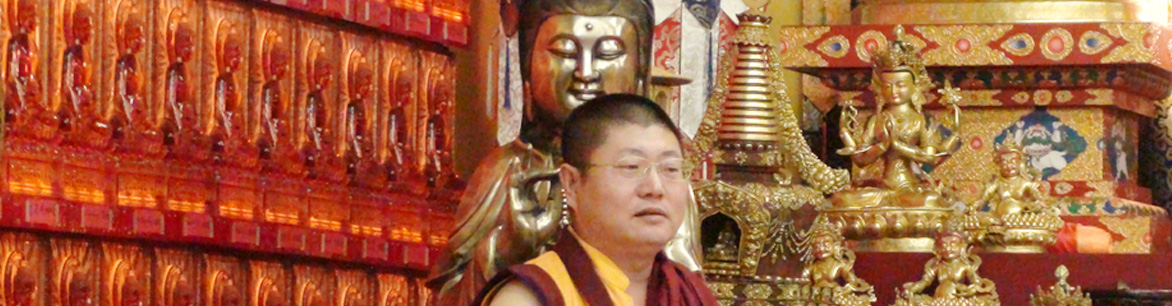 Cultivating one's character and speech in harmony with the guru
Yundan Trinley Dorje Rinpoche
Many people only see me as their teacher, not as family; some even put on an act with me. In fact, when transmitting esoteric teachings, it's difficult to achieve great success if there's a disconnect between you and your teacher.
The reason is simple: it is mainly due to one's own karma that creates a barrier between oneself and one's guru, Buddhas, and Bodhisattvas, causing one's body, speech, and mind to be unable to resonate and unite with the guru, nor with the Buddha's Dharma, Sambhogakaya, and Nirmanakaya stages.
The level of enlightenment we attain through spiritual practice depends on our degree of connection with our guru, Buddhas, and Bodhisattvas. The Buddha has five bodies: Dharmakaya, Sambhogakaya, Nirmanakaya, Sambhogakaya, and Anuttarayogata. Many people are unaware that the fifth body, Dharmakaya, Sambhogakaya, and Nirmanakaya, corresponds to our body, speech, and mind. That is, our body corresponds to the Buddha's Nirmanakaya. Our speech corresponds to the Buddha's speech, thus attaining the Sambhogakaya. Our mind corresponds to the Buddha's Dharmakaya, achieving the fruition of the Dharmakaya.
Our body, speech, and mind are unified with our Dharmakaya, Sambhogakaya, and Nirmanakaya, and with the Dharmakaya, Sambhogakaya, and Nirmanakaya of the Buddha. If one does not cultivate body, speech, and mind, one is not in accord with the attainment of the Buddha's Dharmakaya, Sambhogakaya, and Nirmanakaya. Therefore, the Buddha taught that seeing the Guru is seeing the Buddha's body; hearing the Guru's Dharma teachings is attaining Buddhahood; hearing the Guru transmit the secret teachings of mind is attaining the Dharmakaya. This is why Tantric Buddhism emphasizes the importance of venerating the Guru as the Buddha. Because only an enlightened Guru can guide you to enlightenment.
Understanding the structure of body, speech, and mind in relation to the Guru and Buddha means understanding a part of the structure of life, and more importantly, it allows one to resonate and unite with the Guru, Buddhas, and Bodhisattvas from the very foundation of body, speech, and mind. This is the true meaning of why we pay homage to the Guru, the lineage masters, and all the deities.
If you don't understand this structural relationship, you'll be busy creating negative karma through body, speech, and mind. When you can't connect with your guru or the deities, and are busy fighting and creating the karmic habits of greed, anger, ignorance, pride, and doubt, you are corresponding with your own karma and karmic habits. At the same time, the same habitual seeds planted in your alaya consciousness are instantly drawn out, blossoming and bearing fruit immediately. This process is incredibly fast, beyond your imagination.
When we generate habitual tendencies of greed, anger, ignorance, pride, and doubt, our body, speech, and mind simultaneously attract the same seeds within our alaya consciousness. The more seeds of these causal tendencies we attract to our alaya consciousness, the more evil karma we create, and the more evil karma seeds we store in our alaya consciousness. Therefore, committing the act of killing inevitably accumulates the seeds of killing.
However, if we cultivate Buddhism and cultivate Buddha-nature, it will immediately attract the good, pure, and beginningless pure seeds of practice within our Alaya consciousness. The moment you attract them, purity immediately manifests. As your purity increases and your Buddha-nature shines brighter, you enter the state of "When you realize your own wrongdoing in a single thought, the Buddha-light and spiritual light naturally appear." At this time, you will become aware of your own thoughts and actions, knowing that your body, speech, and mind are attracting only light. Your Alaya consciousness is like a sphere, where all the pure seeds accumulated in past lives shine brightly.
Because you have cultivated a pure practice, all the pure seeds in your Alaya consciousness have sprouted and shone. Those seeds of ignorance, evil, greed, anger, and delusion are also illuminated. Even if there are evil seeds, and evil circumstances arise, your Buddha-light will illuminate all the people, things, and events you face that bring about evil karma.
You might ask, how do I illuminate this? It's through great compassion and skillful means to address the negative karmic conditions before me. For example, if someone killed me in a past life, in this life I will guide them to Buddhahood. Because you guide them to Buddhahood, the seed of that evil karma of killing is transformed. In this way, the seeds of karmic cause and effect, and habitual tendencies in the Alaya consciousness, cannot form a continuous cycle of conflicting rebirths. This is called "resolving cause and effect," or "reversing the course of karma with compassion."
If you are not completely enlightened, and someone killed you in a past life, you will surely kill them in this life. This is why I repeatedly emphasize the need to constantly pay attention to your thoughts and actions, as well as the reactions of your body, speech, and mind. It's to prevent you from creating further conflicting karmic consequences. Otherwise, if someone hits you and you kick them, you'll stir up the seeds of greed, anger, ignorance, pride, and doubt in your Alaya consciousness.
The so-called "attracting" refers to the transmission of power. This transmission happens in an instant, a process so rapid it's beyond what most people can imagine. This is why I want you to pay attention. Never again attract karmic seeds that shouldn't exist. As long as you don't attract impure karmic seeds, you will become increasingly pure.
This also illustrates that "life itself is a form of spiritual practice." When you encounter people, events, or things, you should face them with pure compassion, wisdom, and skillful means. When attacked, don't react impulsively; respond appropriately. If someone insults you, respond with "Namo Amitabha Buddha." If someone hits you, still respond with "Namo Amitabha Buddha." This approach means that whether you insult me or hit me, I don't react; it's as if you didn't insult or hit me at all.
The reasoning behind this is that when evil strikes us, if we do not respond with greed, anger, ignorance, pride, or doubt, we will not have to suffer the consequences of evil again. This is also the main reason why I repeatedly emphasize practicing the precept of "not killing."
Experience these practices in life, and gradually expand your narrow perspective.
-
-
-
-
-
- Vows and Precepts
- Preliminary Foundations of the Path
- Generation Stage
- Meditation Practice
- Precious Human Rebirth
- Impermanence of All Things
- Infallible Cause and Effect
- Suffering of Samsara
- Liberation and Benefit
- Reliance on the Guru
- Refuge
- Prostration
- Generate Bodhicitta
- Vajrasattva Mantra Practice
- Accumulating Merit
- Guru Yoga
-
-
-
-