Dzogchen Fundamentals
- The Dharma Door of Nonduality I
- The Dharma Door of Nonduality II
- The Dharma Door of Nonduality III
- The Dharma Door of Nonduality IV
- Karmic Rebirth
- Keys to Buddha Recitation
- Transforming Mind
- Evaluating One's Non-Attachment to Ego
- The Dharma Door of Nonduality
- Present Actions Hold the Future
- Why Does Guru Appear Angry
- Medicine Buddha Puja Ceremony Liturgy
Essence of Mind
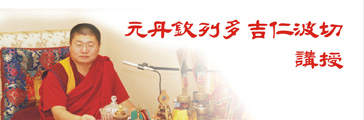
Rinpoche teaches us that in order to find ourselves we must find the nature of our mind. Our minds are easily deceived. If we can find the nature of our mind, we will become enlightened. When one fully understands the law of karma, one begins the path to enlightenment.
The Dharma Door of Nonduality II
The "two" in "non-dualistic Dharma" refers to "duality." In Buddhism, "duality" is enlightenment and non-enlightenment. The process from non-enlightenment to enlightenment is "spiritual practice."The two characters “修” (xiū) and “行” (xíng) also refer to two different things.
"Cultivation" is the continuous process of correcting oneself, ensuring that one's body, speech, and mind align with the practice of enlightenment. "Practice" is doing, encompassing all the processes of doing.
When our spiritual practice reaches its peak and we have completed the process, there is no difference between being enlightened and unenlightened. This is the true meaning of the "non-dualistic path."
In spiritual practice, "non-duality" refers to conventional truth and ultimate truth.
The phenomena of conventional truth are the realms created by cause and effect. These phenomena involve people, events, and things. "People" refers to all life. "Events" are the "objects of perception," or "all realms." This includes the six sense objects perceived by our physical body in the external environment, as well as the causal realms arising from our inner world. "Things" are the laws governing cause and effect. All people and events are generated according to the laws of cause and effect.
The ultimate truth is divided into two kinds: one is "liberation from birth and death", and the other is "ultimate perfection".
"Liberation from birth and death" means understanding the cause and effect of birth and death, and transcending the laws of birth and death.
"Ultimate perfection" has many names in Buddhism, including Mahamudra, Dzogchen, and the One True Realm, etc.